One of the questions my patients who are planning to have breast augmentation surgery or who have recently undergone the procedure ask me most frequently is:
“When can I start exercising after a breast augmentation?”
This question is particularly important for women who exercise regularly, practise Pilates and yoga, or are involved in bodybuilding at a professional level.
In fact, there is no single answer to this question that applies to everyone. The time it takes to return to sport after breast augmentation surgery can vary depending on the surgical technique used, the placement of the implant, the rate of recovery and the type of sport to be undertaken.
Nevertheless, there are some basic guidelines that I recommend to my patients as part of the treatment protocol I have been following for years.
In this article, I will explain in detail when you can start exercising after breast augmentation, which exercises are safe at which stage, and my approach to professional athletes.
Why Are the First 6 Weeks After Breast Augmentation So Important?
Following breast implant surgery, your body does not merely heal the surgical wounds. It also works to adapt to the new anatomical space where the implant has been placed.
The tissue healing that occurs during this process, the settling of the implant into the correct position and the reduction in swelling all take a certain amount of time.
For this reason, it is important to avoid exercises that strain the chest muscles as much as possible, particularly during the first six weeks.
Intense physical activity undertaken at an early age;
- an increase in pain,
- prolonged oedema,
- unnecessarily rushing the recovery process,
- the tissues surrounding the implant being subjected to unnecessary stress
What could be the reason?
That is why I ask my patients to be patient when it comes to exercise during the first six weeks.
The First Week Is a Period of Rest and Recovery
In the first week, my priority isn’t exercise, but making sure my recovery gets off to a healthy start.
This doesn’t mean you have to stay in bed all day.
On the contrary, short walks around the house are beneficial as they promote circulation and reduce the risk of blood clots.
However, during this period;
- fitness,
- running,
- Pilates,
- yoga,
- weight training,
- brisk walks
Not recommended.
Your body needs to rest during these first few days.
When Can You Start Walking?
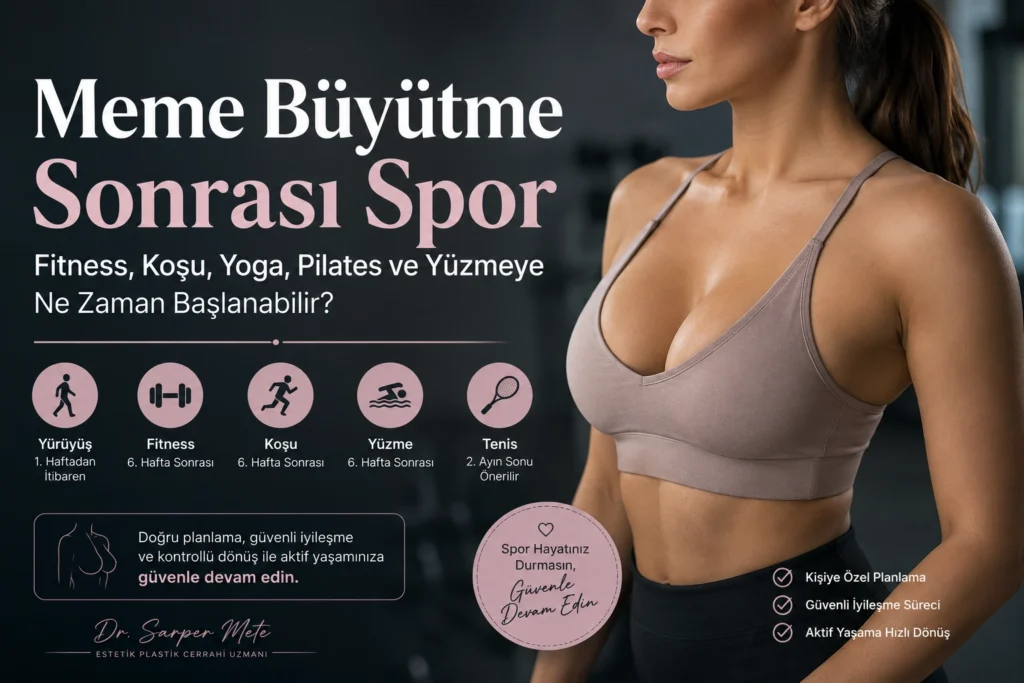
After the first week, I allow most of my patients to go for a walk.
However, the kind of walking I’m referring to here isn’t cardio that really gets your heart rate up; it’s a leisurely stroll.
Walk;
- improves circulation,
- helps patients feel better,
- makes the return to everyday life easier.
However, the duration and pace of the walk should also be increased gradually.
You should not lift weights heavier than 5 kg during the first 6 weeks
In practice, one of the most important rules I tell my patients is quite simple:
Do not lift anything heavier than 5 kilograms during the first 6 weeks.
This does not apply solely to the gym.
In everyday life, too;
- carrying heavy shopping bags,
- lifting a large suitcase,
- carrying a small child,
- doing heavy housework,
- reaching up to the high shelves to retrieve goods
Activities such as these can work your chest muscles more than you might think.
For this reason, during the recovery period, attention should be paid not only to sport but also to everyday activities.
Which sports are off-limits during the first six weeks?
For six weeks, you should avoid exercises that place particular strain on the chest muscles and upper body muscles.
First and foremost among these are:
- bench press,
- push-up,
- shoulder press,
- lat pull-down,
- rowing exercises,
- pull-up,
- bottom,
- calisthenics exercises,
- intense CrossFit workouts
is coming.
It also works in conjunction with the chest muscle;
- shoulder,
- back,
- latissimus dorsi,
- upper abdomen
I do not recommend exercises that place a heavy strain on the muscles during this period either.
I don’t consider high-impact cardio exercises, such as running, to be suitable during the first six weeks.
Can I Do Leg Exercises?
Whilst the answer to this question varies from patient to patient, we are able to adopt a more controlled approach with professional athletes.
From around the third week onwards, controlled exercise may be introduced in patients suitable for machine-based isolated lower limb exercises that do not engage the chest muscles.
For example;
- quadriceps exercises,
- adductor exercises
It can be applied at an early stage.
However, I do not recommend exercises that require a prone position or that indirectly strain the chest muscles during this period either.
Can Professional Sportspersons Have Breast Augmentation Surgery?
One of the misconceptions I frequently come across in society is this:
“If I’m a professional athlete, I can’t have breast augmentation surgery.”
Actually, that is not true.
My clinic treats not only patients who exercise regularly, but also a large number of female athletes who are professionally involved in bodybuilding, work as fitness trainers, and compete in national or international competitions.
Although these patients all have in common that they take part in sport, their surgical plans are completely different from one another.
For me, it is not just the sport the patient practises that is the deciding factor. It is also;
- the thickness of the breast tissue,
- leather quality,
- upper lip fullness,
- the structure of the ribcage,
- the patient’s aesthetic expectations
- and lifestyle
are assessed together.
For this reason, being a professional athlete does not in itself prevent a woman from having breast augmentation surgery.
For Athletes, Is ‘Under-the-Muscle’ or ‘Over-the-Muscle’ the Better Approach?
This is also one of the most frequently asked questions.
Some patients believe that, because they play sport, they must have an over-the-muscle implant fitted.
In my practice, however, there is no such strict rule.
Whilst I prefer the dual-plane (submuscular) technique for some of my professional athletes, the supramuscular (subfascial or Preserve approach) yields better results for some of my patients who have the appropriate anatomy.
What matters here is not the sport the patient practises, but their anatomy.
For example;
- who have sufficient breast tissue,
- with a suitable top sheet,
- in patients where there is a low risk of the implant margins becoming visible
Placement above the muscle can yield very good results.
Conversely, in many professional athletes—particularly those with thin upper pole tissue or where we are aiming for a more natural transition—we confidently apply the dual-plane technique.
In other words, being a professional athlete does not automatically mean that subcutaneous implants cannot be fitted.
Each patient should be assessed on the basis of their own anatomy.
Is Implant Size Important for Patients Who Exercise?
I am often asked this question, particularly by patients who are interested in fitness and yoga.
First of all, I’d like to say this.
Provided there are no medical contraindications, I do not interfere with my patients’ aesthetic expectations.
Ultimately, this operation is a matter for the patient’s own body and their own choice.
My role is to help patients achieve their desired appearance, whilst ensuring they remain within safe limits.
However, when asked for my personal opinion, I generally recommend more moderate implant volumes, particularly for women who are actively involved in sport.
The reason for this is not aesthetic, but functional.
As breast volume increases, so does the weight on the anterior chest wall. This may not be noticeable in everyday life, but the presence of larger implants may be felt during certain movements, particularly in people who engage in intensive exercise.
In particular;
- yoga,
- Pilates,
- functional training,
- gymnastics,
- CrossFit
In sports that require a high degree of flexibility, such as these, large implants may slightly reduce comfort of movement in certain positions where the ribcage is fully extended.
For this reason, when asked for my opinion, I believe that, for professional athletes, as natural and moderate a build as possible may be more comfortable in the long term.
However, I would like to emphasise this point in particular.
This does not mean that patients who opt for large implants cannot take part in sport.
At my clinic;
- 625 cc
- even though she has a 700 cc implant
I have many patients who are actively involved in fitness, work as sports instructors and take part in professional competitions.
Once appropriate surgical planning has been carried out and the recovery process has been successfully completed, these patients are able to continue their active sporting lives.
Therefore, the type of sport practised should not be the sole criterion when selecting the implant volume.
My approach is to determine the implant size that will ensure the patient’s long-term satisfaction by jointly assessing their anatomy, expectations and lifestyle.
When Can You Go Swimming, Do Fitness Training, Play Tennis and Practise Yoga?
Once the first six weeks are over, I allow the majority of my patients to resume exercise in a controlled manner.
However, each sport uses the chest muscles in a different way.
Fitness
After six weeks, you can start with light weights.
It is not advisable to return to your pre-surgery weight on the first day.
As muscle strength will naturally have decreased during this process, the loads should be increased gradually.
Swimming
Once the wound has fully healed and six weeks have passed, you may begin light swimming exercises.
However, in the early days, controlled swimming should be preferred over performance-oriented swimming.
Yoga and Pilates
Although yoga and Pilates are often thought of as gentle forms of exercise, certain poses work the chest muscles quite intensely.
Particular care should be taken during movements where the ribcage is fully extended and the shoulders are stretched back significantly.
For this reason, the turn must be carried out in a controlled manner.
Tennis
Tennis is one of the sports I approach with the greatest caution.
During the serve and forehand-backhand strokes;
- chest,
- shoulder,
- back
The muscles are working quite intensely.
For this reason, with most of my patients, I prefer to wait not just six weeks but until the end of the second month before they return to tennis.
The Biggest Mistake Made When Returning to Exercise
Many patients who feel well six weeks after their operation want to pick up their pre-operative routine where they left off.
I don’t think that’s right.
During the first six weeks, there is naturally some loss of muscle fitness.
For this reason, I recommend that my patients who exercise regularly, in particular, start again using light weights and in a controlled manner, ideally under the guidance of a personal trainer, if possible.
Progressing gradually both reduces the risk of injury and allows the breast tissue to adapt more comfortably to the new situation.
Can ‘Preserve’ (Over-the-Muscle) Breast Augmentation Offer Any Advantages for Professional Athletes?
When planning surgery for professional athletes, consideration must be given not only to the aesthetic outcome but also to the process of returning to sport.
For this reason, in some patients with a suitable anatomy, I may opt for submuscular implant placement, also known as Preserve Breast Augmentation.
As the pectoral muscle is neither cut nor lifted in this technique, there is less muscle trauma during the operation. Consequently, the pain and restricted movement typically experienced, particularly in the first few days, may be less severe in some patients.
This can offer a significant advantage, particularly for patients who compete professionally in sport and wish to return to their season or training programme as quickly as possible, whilst maintaining control over the process.
However, I would like to emphasise a very important point here.
Preserve (submuscular) breast augmentation is not suitable for every patient.
In order for this method to be implemented;
- the presence of sufficient breast tissue,
- sufficient thickness of the soft tissue in the upper lip,
- the low risk of the implant margins becoming visible,
- the patient being an anatomically suitable candidate
is required.
Consequently, simply taking part in sport is not a sufficient criterion for the Preserve technique.
Whilst submuscular placement is the most appropriate option for some professional athletes, in some patients the dual-plane (subcutaneous) technique may yield much more natural and safe results.
My approach has always been to adapt the technique to the patient, rather than making the patient conform to the technique.
In suitable candidates, I have observed that, thanks to the reduced muscle trauma provided by the Preserve technique, the process of returning to exercise—carried out in a controlled manner and in accordance with the doctor’s recommendations—can proceed more comfortably. However, regardless of which technique is used, respecting the recovery process during the first few weeks and planning a gradual return to sport are the most important factors in achieving a successful outcome.
Conclusion
Your sporting life does not come to an end after breast augmentation surgery.
With a properly planned operation, a careful recovery process and a structured programme for returning to sport, the vast majority of my patients are able to return to their previous active lifestyles with ease.
In fact, many of my patients who are professional fitness trainers, yoga instructors or who compete in bodybuilding competitions continue their sporting lives at the same level of performance even after surgery.
What matters is not applying the same rules to everyone, but creating a personalised plan by jointly assessing the patient’s anatomy, the sport they practise and their expectations.
For me, a successful breast augmentation operation is not merely about achieving an aesthetically pleasing result. It is also about achieving a natural and functional outcome that allows the patient to return with confidence to their daily life, work and sporting activities, and to live happily for many years to come.
Frequently Asked Questions
When can I start walking for exercise after breast augmentation?
I recommend resting during the first week after the operation. After the first week, I allow the majority of my patients to go for gentle walks. However, I generally prefer to wait until the first six weeks are over before allowing brisk walking, running or cardio exercises that significantly raise the heart rate.
When can you start exercising after breast augmentation?
You should take a break from fitness exercises that intensely work the chest, shoulder and back muscles for the first six weeks. After six weeks, I recommend starting again with light weights and in a controlled manner. It is not advisable to return to your previous training programme from day one.
Can I lift weights after breast augmentation?
I do not recommend lifting anything heavier than 5 kilograms during the first six weeks. This applies not only to weights at the gym, but also to everyday activities such as carrying heavy shopping bags, suitcases or children.
When can you start running after breast augmentation?
During running, the chest area is subjected to repeated impacts and the heart rate rises significantly. For this reason, I generally do not recommend running during the first six weeks. After that, however, you can start running in a controlled and gradual manner.
When can you start swimming after breast augmentation?
Once the wound has fully healed and the first six weeks have passed, you may begin light swimming. However, during the initial training sessions, you should opt for controlled, short-duration swims rather than performance-focused sessions.
Can you do yoga and Pilates after breast augmentation?
Yes. However, as there are certain poses in yoga and Pilates that place a heavy strain on the chest muscles or put the ribcage under significant strain, they are not recommended for the first six weeks. After that, you can start practising them in a controlled manner.
When can you play tennis after breast augmentation?
Tennis is one of the sports that places heavy demands on the chest, shoulder and back muscles. For this reason, I find it more appropriate to wait not just for the first six weeks to pass, but for the entire second month to be over, in the case of most of my patients.
Can professional athletes have breast augmentation surgery?
Yes. I have many patients at my clinic who are professional fitness trainers, sports coaches and bodybuilding competitors. Following appropriate surgical planning and a managed recovery process, they are able to resume their active sporting lives.
Can submuscular breast augmentation be performed on patients who exercise?
Yes. Being a professional athlete does not in itself preclude submuscular breast augmentation surgery. Depending on the patient’s anatomy, the dual-plane (submuscular) technique may be more suitable for some athletes, whilst the subcutaneous technique may be more appropriate for others. If the patient is a suitable candidate, the Preserve technique is also one I recommend for my athlete patients.
Do large breast implants cause problems for patients who exercise?
Many of my patients who have had large implants continue to lead active sporting lives. However, when asked for my personal opinion, I believe that more moderate implant volumes may offer advantages in terms of comfort during movement, particularly for women who engage in intensive sport. Nevertheless, with appropriate planning, large implants can also yield successful results.
What should you bear in mind when starting to exercise after breast augmentation?
It is not advisable to try to return to your pre-surgery level of performance during your first training session. Weights and exercise intensity should be increased gradually, and, if possible, you should progress in a controlled manner under the guidance of a personal trainer.
Will I be able to lift my arm comfortably after breast augmentation?
Yes. Arm movements are not completely prohibited in daily life. However, during the first few weeks, you should avoid sudden, strenuous arm movements or those involving heavy loads. Thanks to the exercises we prescribe after the operation, shoulder range of motion is maintained in a controlled manner, and most patients are able to return to their daily activities comfortably within a short time.
Stay up to date with the latest news
- Do Breast Implants Rotate? (Implant Rotation)

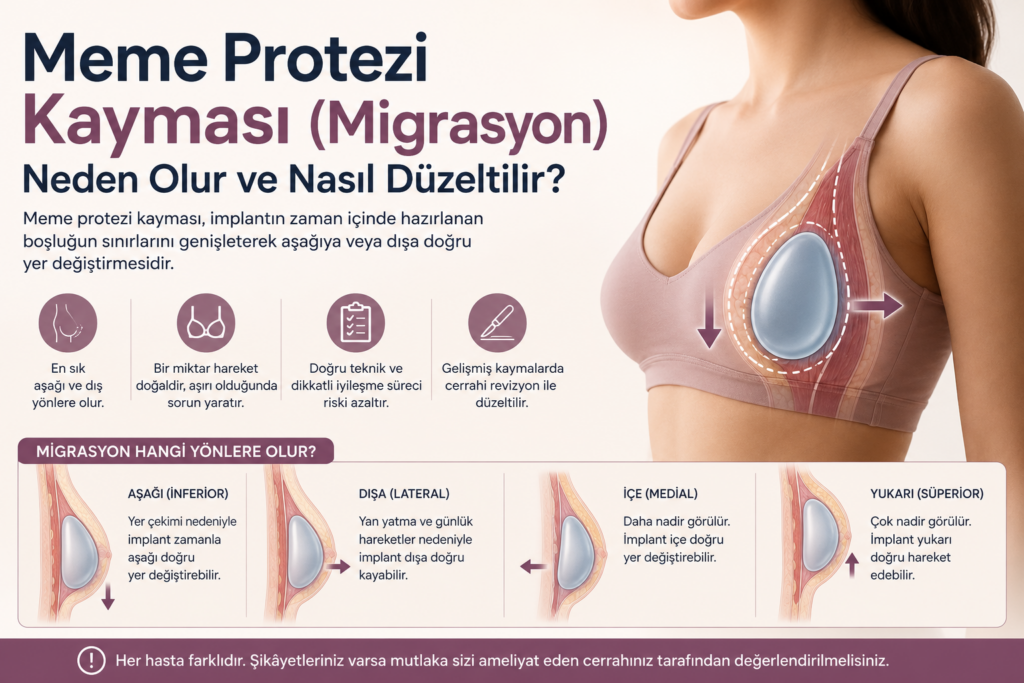
- Breast Implant Displacement (Migration): What Causes It and How Can It Be Corrected?
- Sexual Life After Breast Augmentation: When Is It Safe?
- Exercise After Breast Augmentation: When Can You Start Fitness, Running, Yoga, Pilates and Swimming?
- Can Breast Implants Burst? What You Need to Know About Implant Rupture
- What is a Fibroadenoma?