
After breast augmentation surgery, some patients may, over time, use the following expressions:
- “Doctor, my prosthesis has slipped down.”
- “My breast moves around more than it used to.”
- “It feels as though my silicone is moving outwards.”
- “My denture moves around a lot.”
In fact, a significant proportion of the symptoms described by patients may be related to what is medically known as implant migration, that is, the displacement of the breast implant.
Of course, not every movement of an implant constitutes migration. In fact, it is entirely natural and to be expected for an implant to move to a certain extent following a successful breast augmentation operation. The important thing is that this movement remains within normal limits and does not become so pronounced as to compromise the aesthetic result.
In this article, I will explain in detail why breast implant displacement occurs, in which circumstances it is considered normal, when it requires treatment, and my own surgical approach.
Does every breast implant that moves mean it has slipped?
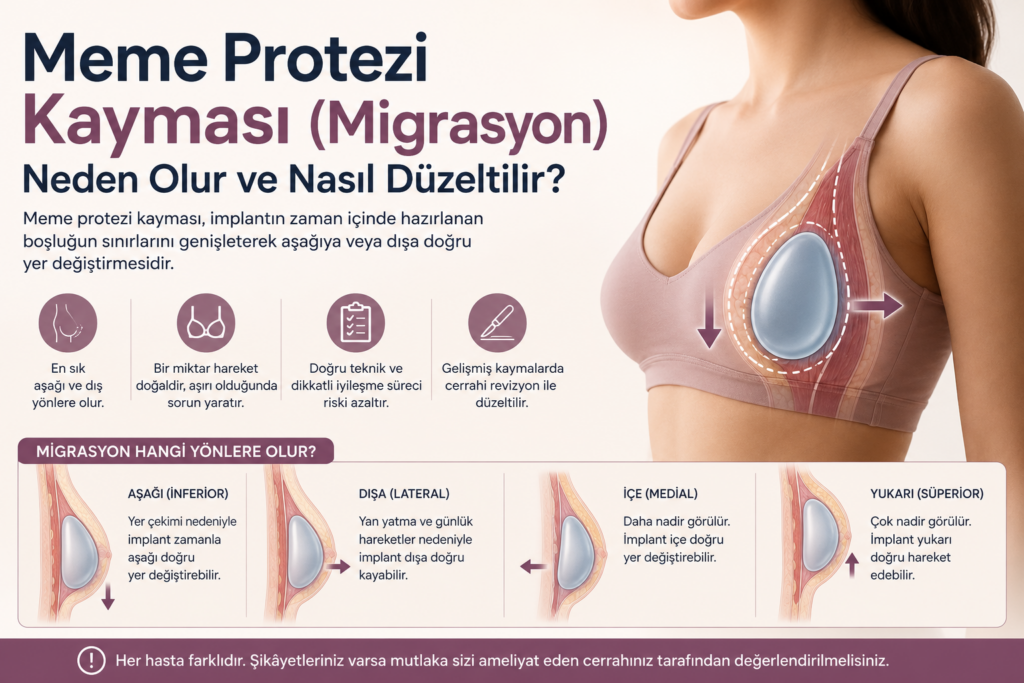
Breast implant migration refers to the displacement of the implant from its intended position to a different location as the boundaries of the pocket created during surgery expand over time.
The most common directions of migration are downwards and outwards. The main reason for this is both the force of gravity pulling the implant downwards and the natural movement of the breasts during daily life and whilst sleeping.
However, there is one important detail here.
Migration is not the same as the breast’s natural movement.
Is Every Movement of a Prosthesis a Problem?
Absolutely not.
In fact, a breast that looks natural moves to a certain extent in everyday life. When walking, exercising or lying on one’s right or left side, the breast tissue changes position.
Breast implants also closely mimic the behaviour of natural breasts.
In fact, in my opinion, two breasts that do not move at all—as if they were stuck to the chest wall—do not look natural.
Consequently, a certain amount of movement is to be expected following a successful breast augmentation operation.
The problem is that the implant begins to move beyond the boundaries of the prepared pocket, thereby compromising the aesthetic appearance. This is what we refer to as implant migration.
Why Do Breast Implants Shift?
There is no single cause of breast implant displacement. It is most often the result of a combination of factors.
The planning of the pocket into which the implant is placed, the structure of the patient’s connective tissue, the surgical technique used, the characteristics of the implant and the post-operative recovery process may all play a role in the development of migration.
In my own practice, I pay particular attention to the following factors:
- The patient’s breast anatomy and skin quality,
- Planning the site prepared for the implant,
- The strength of connective tissue,
- The extent to which the breasts are preserved in the early post-operative period.
In some patients, even though everything has been done correctly from a technical point of view, the implant may become increasingly mobile over time because the connective tissue is looser than expected. In contrast, in some patients, the implant may retain its position almost exactly as it was on the first day for many years.
For this reason, it is not correct to attribute migration solely to the surgical technique or solely to the patient.
Why Are Early-Life Traumas Important?
During the operation, a special pocket is created for the implant.
During the first few weeks, whilst the body is healing this new anatomical structure, it begins to form a natural capsule around the implant. Although this process is not visible from the outside, it continues actively inside the body.
That’s why I attach particular importance to the first six weeks.
During this period, any blows, heavy pressure or unnecessary trauma to the breast area may adversely affect the healing of the implant pocket.
Of course, it would be incorrect to say that a single movement or a single event causes migration. However, I believe that taking care during the early stages contributes to the implant healing healthily in its intended position.
For this reason, I advise my patients to wear their special medical bras regularly during this period, to avoid strenuous exercise, and to steer clear of situations that could put unnecessary pressure on the breasts.
In this article, I have explained in detail the points to bear in mind regarding your sex life following breast augmentation. (We will include an internal link here to the article ‘Sex Life After Breast Augmentation’.)
The Relationship Between Modern Implants and Migration
Thanks to the modern silicone implants used in recent years, we are able to achieve results that look and feel much more natural.
One of the key characteristics of these implants is that they exhibit a high degree of biocompatibility with the body and can help to promote the formation of a softer capsule around them.
In my own clinical experience, whilst this feature offers a significant advantage in terms of a natural sense of movement, it may also make the correct planning of the implant pocket and the careful management of the early healing phase all the more important.
For this reason, when selecting an implant, the surgeon must take into account not only the implant brand but also the patient’s anatomy, connective tissue and long-term stability.
Was the Preserve Technique Developed to Prevent Migration?
One of the main aims of the Preserve approach, developed in recent years particularly by Motiva, is to create a more stable pocket for the implant by preserving the natural connective tissue structures within the breast as much as possible.
In this technique, rather than conventional surgical dissection, the aim is to minimise tissue separation, and a different approach is adopted to preserve the supportive structures within the breast.
The scientific basis for this idea is highly valuable. However, in my own practice, I do not believe that the Preserve technique is suitable for every patient.
In particular;
- who have marked breast asymmetry,
- where the base of the breast needs to be reshaped,
- with a narrow lower pole,
- with noticeable sagging,
- in patients requiring re-planning of the implant site using conventional methods,
Releasing the supporting ligaments and repositioning the anatomy is often a key part of achieving a successful outcome.
For this reason, my approach is not to adapt the technique to the patient, but to select the surgical technique best suited to the patient’s anatomy.
How Can You Tell if a Breast Implant Has Slipped?
Breast implant displacement is often first noticed by the patient herself.
In my surgery, my patients usually describe this using the following phrases:
- “Doctor, my prosthesis moves more than it used to.”
- “It feels as though my silicone is moving outwards.”
- “When I lie down, my breast splay out to the side.”
- “One of my breasts sits lower than the other.”
Of course, not every instance of this does necessarily mean the implant has migrated. Particularly with large-volume implants or in patients whose natural breast tissue is softer, some movement of the implant may be entirely normal.
Therefore, what matters is not simply that the implant moves; rather, it is whether the movement becomes so pronounced that it compromises the aesthetic appearance or creates a noticeable difference between the two breasts.
A definitive diagnosis, however, can only be made through a physical examination.
Can Breast Implant Displacement Be Corrected Without Surgery?
I’m asked this question quite often.
Unfortunately, it is not possible to correct a genuine herniation through massage, exercise or external manoeuvres.
This is because the problem here is not the implant itself, but the fact that the pocket in which the implant is situated has expanded over time.
Consequently, treatment should target the implant site rather than the implant itself.
This point differs from implant rotation. Whilst manual correction may be possible in some selected cases of implant rotation, the permanent solution for migration is usually surgical revision.
For detailed information on implant rotation, you can read my article entitled ‘Do Breast Implants Rotate? (Implant Rotation)’. (Internal link.)
How is Breast Implant Displacement Treated?
The treatment plan varies depending on the severity of the migration.
In cases of minor movement, simply monitoring the situation may sometimes be sufficient. However, revision surgery may be necessary in cases where the implant has shifted to such an extent that it compromises the aesthetic result.
The primary aim of these operations is to reshape the enlarged implant pocket so that the prosthesis remains in a more stable position.
Where necessary, the capsule is reduced, the implant site is re-planned, and in some patients, the size or placement plan of the implant may also be reviewed.
The approach taken will vary from patient to patient. For this reason, revision surgery may require more planning than the initial operation.
Can Breast Implant Displacement Be Prevented?
As with any surgical procedure, it is not possible to completely eliminate migration.
However, both the technique used by the surgeon and the patient’s adherence to post-operative advice can help to reduce this risk.
I make the following specific recommendations to my own patients:
- Please use the medical bra as recommended for the first six weeks.
- Protect the breast area from blows and unnecessary trauma.
- Do not start any strenuous physical activities without your doctor’s permission.
- Avoid movements that could put excessive pressure on the breast.
- Don’t miss your check-ups.
The first few weeks are the most critical period for the healthy healing of the implant site. The care taken during this process can also have a positive impact on long-term outcomes.
Conclusion
Implant displacement is a condition that can occur following a successful breast augmentation operation, but it should not be confused with every instance of implant movement.
A certain degree of implant movement is natural and is often part of what gives the breasts their natural appearance. The key point is that this movement should not become so pronounced as to compromise the aesthetic appearance, nor should it cause the patient any functional or cosmetic problems.
In my own surgical approach, the most important steps in preventing migration are: accurate patient assessment, personalised surgical planning, and careful management of the post-operative recovery period.
If you think your implant has shifted, notice a noticeable change in the shape of your breasts, or feel that your implant is moving more than usual, the best course of action would be to have this assessed by the surgeon who performed your operation, rather than drawing your own conclusions.
Frequently Asked Questions
What is breast implant displacement (migration)?
Breast implant displacement refers to the movement of the implant away from its intended position as the boundaries of the pocket created during surgery gradually expand over time. It is most commonly observed in a downward and outward direction. However, not every movement of the implant constitutes displacement; a certain degree of movement is considered normal.
Why do breast implants shift?
There is no single cause of breast implant displacement. The patient’s connective tissue, breast anatomy, surgical planning, the characteristics of the implant pocket, the healing process and any trauma sustained during the post-operative period may all play a part. In many cases, several factors are at play simultaneously.
How can you tell if a breast implant has slipped?
Patients often describe this as: ‘My implant is moving around a lot’, ‘My breast is shifting outwards’ or ‘One of my breasts is lower than the other’. However, a definitive diagnosis can only be made through a clinical examination. Not every implant that moves is necessarily shifting out of place.
Can breast implant displacement be corrected without surgery?
No. A genuine case of implant displacement cannot be corrected by massage or exercise. This is because the problem lies in the enlargement of the pocket in which the implant is situated. Where a permanent solution is required, revision surgery is performed to reshape the implant pocket.
Why do breast implants shift downwards or outwards?
Gravity causes the implant to shift downwards over time. In addition, outward forces may act on the implant due to the natural movement of the breasts during daily activities and whilst sleeping. These movements may become more pronounced in patients with weak connective tissue or in whom the implant pocket widens over time.
Is breast implant displacement dangerous?
Migration does not pose a life-threatening risk. However, it can affect the aesthetic appearance, cause asymmetry between the two breasts and may cause discomfort in some patients. It is therefore important that the surgeon assesses the situation if a noticeable change in shape is observed.
Can breast implant displacement be prevented?
Although it is not always possible to prevent it entirely, the risk can be reduced. Proper surgical planning, the selection of a suitable implant, the use of a medical bra as recommended, and, in particular, protecting the breast area from trauma during the first six weeks are important in this regard.
Are breast implant displacement and implant rotation the same thing?
No. In migration, the implant shifts in a different direction within the socket. In rotation, however, the implant rotates around its own axis. The treatment approaches may also differ.
Stay up to date with the latest news
- Do Breast Implants Rotate? (Implant Rotation)

- Breast Implant Displacement (Migration): What Causes It and How Can It Be Corrected?
- Sexual Life After Breast Augmentation: When Is It Safe?

- Exercise After Breast Augmentation: When Can You Start Fitness, Running, Yoga, Pilates and Swimming?

- Can Breast Implants Burst? What You Need to Know About Implant Rupture
- What is a Fibroadenoma?