
Following breast augmentation surgery, although it is rare, my patients may approach me with the following comments:
- “Doctor, it feels as though my prosthesis has twisted inside.”
- “All of a sudden, the shape of my breast changed.”
- “Could my denture have come loose?”
- “I wonder if my silicone implant might have flipped over?”
Although a significant proportion of these complaints are referred to by the general public as ‘prosthesis rotation’, the medical term for this is implant rotation.
Fortunately, implant rotation is a relatively rare occurrence. Moreover, not every case of a prosthesis rotating is the same. Many factors can influence this, such as the shape of the implant used, the pocket into which the implant is placed, the capsule that forms around it, and the patient’s anatomy.
In this article, I will explain in detail what implant rotation is, in which patients it may occur, how it is treated, and my own surgical approach.
What is Implant Rotation?
Implant rotation is the rotation of the breast implant around its own axis within the prepared pocket.
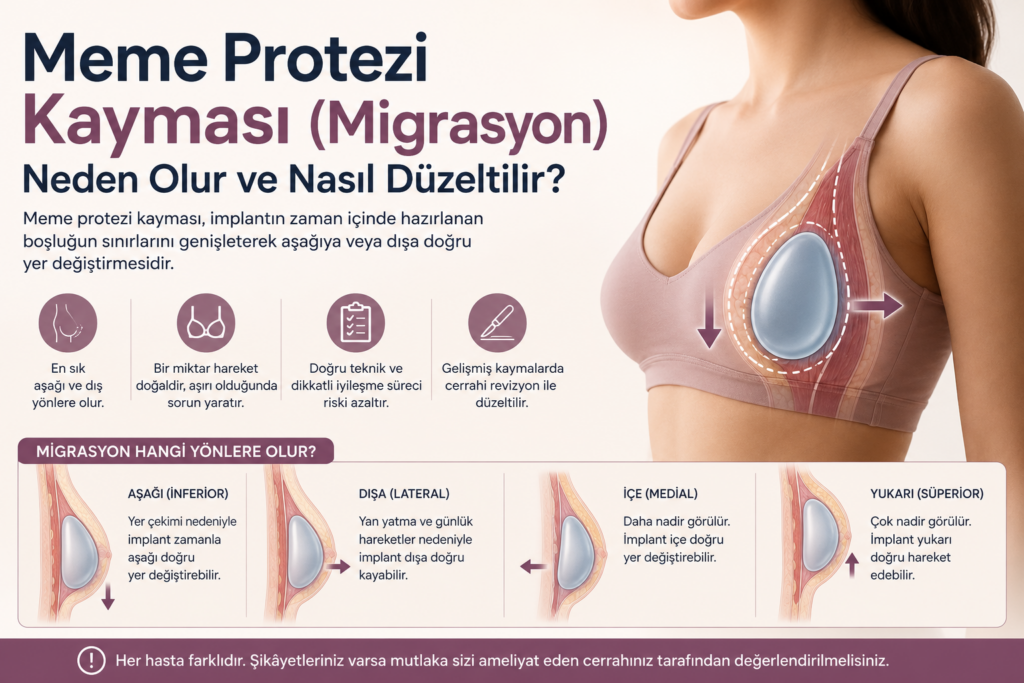
This situation is different from the implant migration I described earlier.
In migration, the implant moves to a different location by expanding the boundaries of the pocket in which it is situated, whereas in rotation, the implant changes its orientation whilst remaining within the same pocket.
Rotation can also manifest in different ways, and not every type of rotation produces the same clinical outcome.
There Are Different Types of Implant Rotation
Implant rotation is not a single, uniform problem. In my own clinical practice, I mainly encounter two different types of rotation.
The first of these is the ‘flip-flop’ deformity, caused by the front and back surfaces of the implant swapping positions. The second is the rotation of the implant to the right or left on its own base. The causes, timing of onset and effects on the breast may differ between these two conditions.
What is Flip-Flop Deformity?
In flip-flop deformity, the implant effectively somersaults inside the joint and rotates so that its anterior surface faces the posterior surface.
In my own practice, I most frequently encounter this situation in two different groups of patients.
The first group consists of patients in the early recovery phase following surgery. Unexpected trauma to the breast or excessive mechanical stress, whilst the implant pocket has not yet fully healed, may set the stage for the implant to rotate. For this reason, I particularly recommend that the breasts be carefully protected during the first few weeks.
The second group consists of revision patients who underwent breast augmentation and lift surgery many years ago and who have high-volume implants. I often encounter ‘flip-flop’ deformity, particularly in patients where many years have passed since the surgery and the implant pocket has widened over time.
Of course, these observations are based on my own clinical experience, and the same mechanism does not apply to every patient.
Rotation About the Same Axis
Another type of rotation is when the implant rotates round its own axis, either to the right or to the left, within the pocket in which it is situated.
This type of rotation produces different results depending on the shape of the implant.
With round implants, even if the implant rotates around its own axis, there is usually no noticeable change in the appearance of the breast. This is because all sides of the implant are symmetrical.
With anatomical (teardrop) implants, however, the situation is entirely different. As the upper and lower poles of teardrop implants are shaped differently, even a slight rotation can significantly alter the shape of the breast. For this reason, rotation is a much more significant concern for the surgeon in patients who have anatomical implants.
Can the Choice of Implant Affect the Risk of Rotation?
When assessing the risk of rotation, it is necessary to consider not only the shape of the implant, but also the preparation of the implant site, the patient’s anatomy and the characteristics of the implant to be used.
In my own practice, when I need to use anatomical (teardrop-shaped) implants in patients, I select the implant whilst taking long-term stability into account. One of the reasons for this is that I believe the formation of a tighter capsule around the implant may contribute to its stability.
Ergonomic round implants, developed in recent years, have emerged as a significant alternative in this regard. Thanks in particular to their ability to create a more natural fullness at the inferior pole, especially when standing, they have now become a successful option for certain patient groups for whom teardrop implants were previously the preferred choice.
For example, Motiva Ergonomix implants can create a more natural breast shape when standing, thanks to the effects of gravity. The more recently developed Ergonomix 2 technology, meanwhile, aims to further enhance this natural behaviour. Consequently, in some patients for whom we would previously have considered anatomical implants, we are now able to achieve very natural results using ergonomic round implants.
This approach makes it possible both to achieve a natural breast shape and to minimise some of the disadvantages associated with the rotation of anatomical implants.
How Can Breast Implant Rotation Be Detected?
Not every change in breast shape means that the implant has rotated.
During the first few weeks following surgery, patients may occasionally think that their implants have rotated, due to uneven distribution of oedema, the implants not yet having settled into their final position, or differences in the rate of healing between the two breasts.
In the case of actual implant rotation, however, an unexpected change in the shape of the breast usually occurs. Particularly in patients with anatomical (teardrop) implants, a shift in the fullness of the lower part of the breast, a distortion of the breast contour, or the breast taking on an unusual appearance may be noticeable.
In the case of round implants, however, rotation does not usually result in any visible deformity from the outside. For this reason, a definitive assessment can only be made during a clinical examination.
My patients usually tell me:
- “One morning when I woke up, the shape of my breast had changed.”
- “It felt as though my prosthesis had moved inside.”
- “A different protrusion has formed on one side.”
They come forward with complaints such as these.
However, not all of these complaints indicate rotation. During the examination, the movement of the implant, the condition of the implant pocket and the breast tissue must be assessed together.
Can Breast Implant Rotation Be Corrected Without Surgery?
The answer to this question depends on the type of rotation and when it was noticed.
In the case of certain rotations that occur particularly in the early stages following surgery, the implant can be repositioned correctly through appropriate manipulation. In my own practice, I prefer to consider this method first in suitable patients.
However, this method is not suitable for every patient and can only be carried out after the structure of the implant, its rotation and the condition of the implant site have been assessed during the consultation.
If the implant keeps rotating or the implant pocket has widened significantly, surgical revision may be required to provide a permanent solution.
How is Breast Implant Rotation Treated?
Treatment is planned entirely according to the cause of the rotation.
If the problem is that the implant pocket has expanded, the pocket is reshaped during revision surgery to restore it to the correct size. Where necessary, the implant is replaced and a new pocket is prepared to ensure the implant sits more securely.
Whilst a breast lift alone may be sufficient for some patients, additional procedures such as a breast lift or implant replacement may also be required, particularly for patients who had surgery several years ago and have since experienced changes in their breast tissue.
For this reason, there is no single treatment method that can be applied to every patient in cases of implant rotation. Surgical planning must be entirely tailored to the patient’s anatomy and the cause of the rotation.
Can Implant Rotation Be Prevented?
As with any surgical complication, it is not possible to completely eliminate implant rotation. However, with appropriate patient selection, the right choice of implant and meticulous surgical planning, this risk can be significantly reduced.
In my own practice, I take care to plan the implant site on a patient-by-patient basis and to select implants not only on the basis of aesthetic expectations but also with long-term stability in mind.
Following the operation, it is of the utmost importance that patients wear the recommended bra, particularly during the first few weeks, protect the breast area from impact, and avoid activities that could place excessive strain on the breasts until the healing process is complete.
For more detailed information on what to bear in mind during the initial recovery period, you may also wish to read my article entitled ‘Sexual Life After Breast Augmentation’.
Conclusion
Implant rotation is a rare condition, but one that can be successfully treated when properly assessed.
Not every change in breast shape means that the implant has rotated. Similarly, not every rotation requires surgery. In some cases, particularly those detected at an early stage, the implant can be repositioned correctly using appropriate techniques. However, in cases of recurrent rotation or where the implant pocket has permanently widened, revision surgery offers the most reliable solution.
For this reason, if you notice an unexpected change in the shape of your breasts following breast augmentation surgery, the best course of action would be to have this assessed by the surgeon who performed your operation, rather than making a decision on your own.
Frequently Asked Questions
Can a breast implant really rotate?
Yes. Although rare, a breast implant may change position within the pocket into which it has been inserted. This condition is known as implant rotation. However, not every movement of an implant constitutes rotation, and a definitive assessment must be made during a plastic surgery consultation.
Is breast implant rotation dangerous?
Implant rotation is not usually an emergency or a life-threatening condition. However, it can cause a marked distortion of the breast shape. It should be assessed, particularly in the case of anatomical (teardrop) implants, as it may affect the aesthetic appearance.
Would it be a problem if a round prosthesis rotated?
In most cases, no. As round implants have a similar shape in all directions, they do not cause any noticeable change in appearance even if they rotate around their own axis. However, if the silicone base rotates so that it faces the front, a distortion in shape occurs.
Why is it easier to notice when a Damla prosthesis rotates?
As the upper and lower poles of teardrop (anatomical) implants are shaped differently, the shape of the breast may also change when the implant rotates. Consequently, rotation is much more noticeable with teardrop implants than with round implants.
Does a breast implant rotation correct itself?
In some cases of early rotation, the implant can be repositioned correctly through appropriate manipulation. However, surgical revision may be required in cases of recurrent rotation or where the implant site has widened. The most appropriate approach is determined following an examination.
Are implant rotation and migration the same thing?
No. In rotation, the implant changes direction within the same socket. In migration, however, the implant moves downwards, outwards or to a different position, thereby expanding the boundaries of the prepared socket. The treatment plans for these two conditions may also differ.
How can implant rotation be prevented?
Although the risk of rotation cannot be completely eliminated, choosing the right implant, planning the pocket to suit the patient and following post-operative advice can reduce this risk. It is particularly important to protect the breasts from impact, especially during the first few weeks, and to follow the surgeon’s advice.
What should I do if I think my breast implant has rotated?
If you notice any sudden changes in the shape of your breast, noticeable asymmetry or anything that suggests the implant has shifted, do not attempt to treat it yourself. The best course of action would be to consult the plastic surgeon who performed your operation for an examination.
When does a breast implant rotate?
Implant rotation may occur in the early stages of surgery, before the implant pocket has fully healed, or it may develop years later as a result of the implant pocket gradually widening over time. The cause and timing of rotation may vary from patient to patient. This point ties in well with the content, as it supports the observations you described in the article regarding ‘early-stage trauma’ and the ‘flip-flop’ phenomenon seen after 7–8 years.
Stay up to date with the latest news
- Do Breast Implants Rotate? (Implant Rotation)

- Breast Implant Displacement (Migration): What Causes It and How Can It Be Corrected?
- Sexual Life After Breast Augmentation: When Is It Safe?

- Exercise After Breast Augmentation: When Can You Start Fitness, Running, Yoga, Pilates and Swimming?

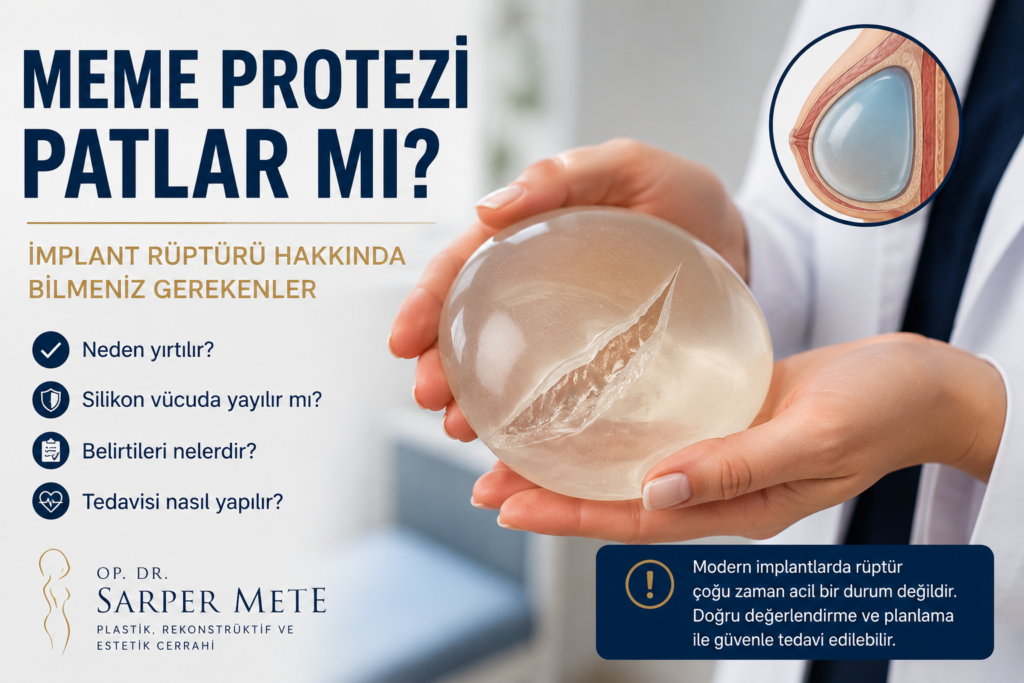
- Can Breast Implants Burst? What You Need to Know About Implant Rupture
- What is a Fibroadenoma?