Why Did I Write This Article?
“Doctor, how many cc of implant do I need?”
This is one of the questions I hear most frequently from my patients before breast augmentation surgery. However, choosing an implant is not simply a matter of deciding how many cc to use. Even two different implants of the same volume can create a completely different appearance from one person to another.
To achieve a natural result that harmonises with your body, it is not just the volume of the implant that must be taken into account; your breast and chest structure, your existing breast tissue, the width of your ribcage, the elasticity of your skin and your aesthetic expectations must all be assessed together.
In this article, I will explain in detail how to choose a breast implant, which criteria are important, and why the same implant is not suitable for every patient.
What Will You Learn on This Page?
- How do you choose breast implants?
- How is the required implant volume (in cc) determined?
- How does breast anatomy affect the choice of implant?
- Why is the width of the breast base important?
- What is a projection (profile)?
- Is a small implant or a large implant more suitable?
- Why does the same implant look different in different people?
How Do You Choose Breast Implants?
One of the issues patients are most frequently curious about prior to breast augmentation surgery is which implant is suitable for them. However, choosing an implant is not simply a matter of deciding ‘how many cc to use’.
The aim of a successful breast augmentation procedure is not merely to increase volume; it is to achieve a result that is in harmony with the patient’s body shape, looks natural and will ensure long-term satisfaction.
For this reason, a number of factors are taken into account when selecting an implant. These include the width of the breast base, the thickness of the existing breast and chest tissue, the structure of the rib cage, skin elasticity, the degree of breast sagging, and the patient’s aesthetic expectations.
Just as every patient’s anatomy is different, so too are their expectations regarding the outcome. For this reason, whilst the same implant may look extremely natural in one person, it may not produce the desired result in another.
How Do I Plan My Implant?
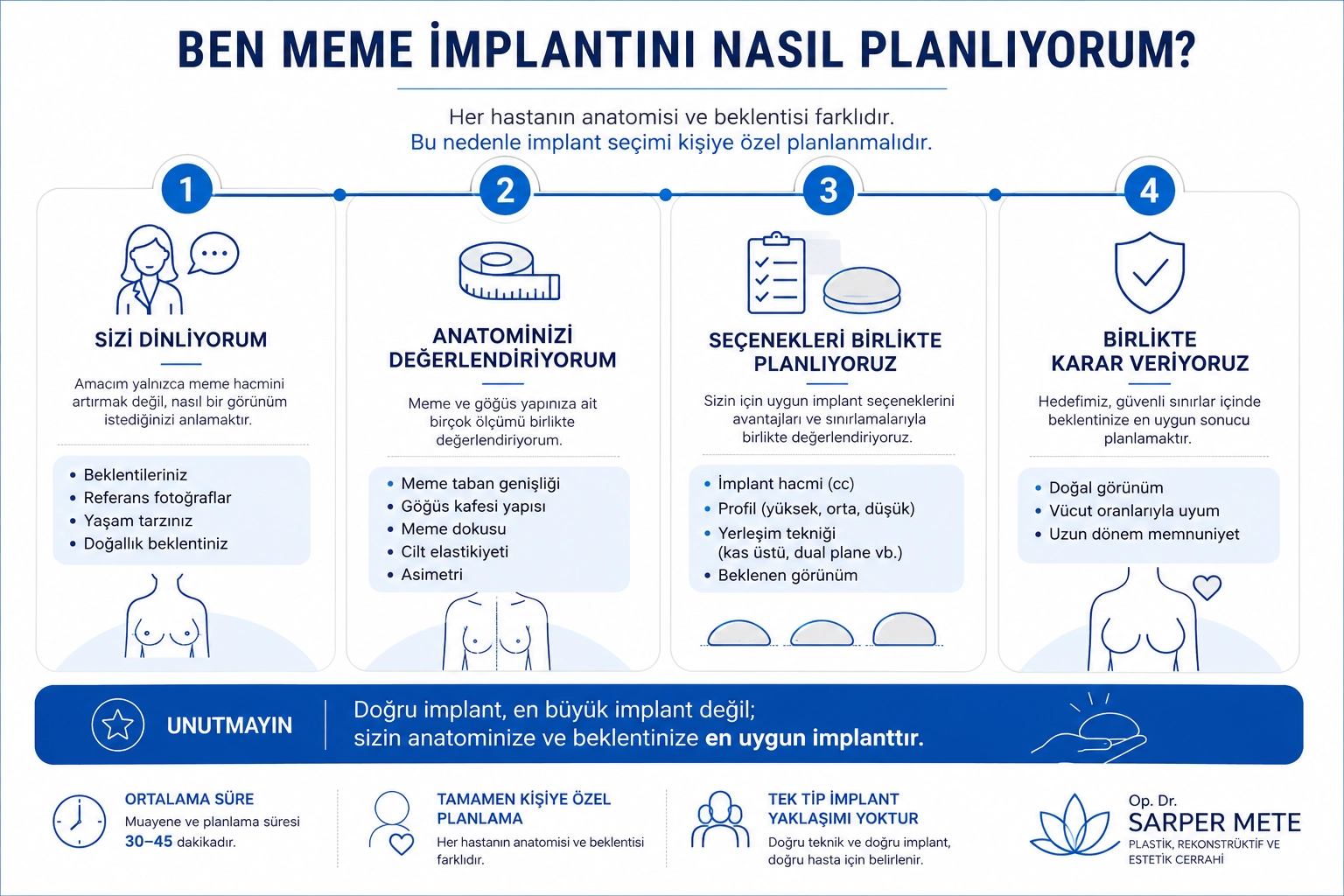
In my own practice, I do not base implant planning solely on anatomical measurements.
Of course, during the consultation, I carry out a detailed assessment of each patient’s breast base width, chest structure, existing breast tissue, skin elasticity and body proportions. These are essential steps in planning a safe and successful operation.
However, there is another issue that is just as important to me as these measurements: being able to properly understand what kind of result the patient is looking for.
For this reason, during the consultation, I ask my patients to share with me photographs of the breast appearance they like. These may be results from previous operations, images they have seen on social media, or photographs of celebrities wearing bikinis.
The aim here is not to replicate any particular person exactly. The aim is to understand as accurately as possible what kind of fullness, décolletage, breast shape and body proportions the patient envisages.
I will consider this expectation alongside the anatomical assessment I have carried out. If the desired implant size or the intended appearance could pose a risk to health or aesthetics in the long term, I will explain the reasons for this, as well as the advantages and disadvantages, in detail.
However, provided the patient’s expectations are consistent with their anatomical structure and medically safe, my aim is not to impose my own aesthetic vision on the patient. On the contrary, whilst remaining within scientific boundaries, I aim to achieve a result that is as close as possible to what my patient envisages.
This is because, in my view, a successful breast augmentation operation is not merely one that is technically well-executed; it is also one in which the patient’s expectations have been correctly understood and met.
Factors Affecting the Choice of Breast Implants
The choice of implant is not based on a single criterion. A personalised plan is drawn up for each patient by assessing all of the following factors together.
- Breast base width
- The thickness of the existing breast tissue
- The width and shape of the ribcage
- Skin elasticity
- The degree of breast sagging
- The patient’s height and shoulder width
- General body proportions
- Lifestyle and sporting habits
- Aesthetic expectations
Each of these factors can directly influence the implant’s volume, width, projection and placement plan.
cc (Volume) Is Not Sufficient on Its Own
One of the questions patients ask most frequently before breast augmentation surgery is, ‘How many cc of implant do I need?’ We also often see online that the choice of implant is assessed solely on the basis of this figure.
However, implant volume is just one of the factors that determine the success of a breast augmentation operation.
For example, a 300 cc implant;
- It can create a rather full appearance in someone with a slender build and a narrow ribcage,
- On someone with a fuller bust, however, it may look much more natural and proportionate.
Similarly, whilst a 400 cc implant is considered large for one patient, it may produce an anatomically very balanced result in another.
For this reason, it is not correct to choose an implant based solely on the cc value. Even implants of the same volume can produce completely different results depending on the individual’s breast structure and body proportions.
Why Is Breast Base Width So Important?
Breast base width is one of the most important anatomical measurements in implant planning. This is because the width of the breast implant to be used must be compatible with the patient’s natural breast contours.
When a wider-than-normal implant is chosen;
- the implant may shift towards the armpit,
- the distance between the two breasts may become smaller than necessary,
- The natural contour of the breasts may be altered.
Conversely, if an implant that is too small is used, the breast volume may not appear sufficiently full and the upper pole support may not reach the desired level.
For this reason, the width of the breast base is carefully measured during the consultation, and the diameter of the implant is planned accordingly.
How Does the Structure of the Rib Cage Affect the Choice of Implant?
Every person’s ribcage is different.
Whilst some people have a narrower, rounder ribcage, others may have a wider or flatter one. These anatomical differences directly affect both the width and the projection of the breast implant to be used.
For example, the same implant;
- it can create a more pronounced cleavage in a narrow ribcage,
- In the case of a broad ribcage, it can create a more natural and balanced appearance.
For this reason, the choice of implant should be assessed not only on the basis of breast volume, but also in conjunction with the overall anatomy of the ribcage.
Why is Existing Breast and Chest Tissue Important?
One of the most important factors determining the choice of implant is the patient’s existing breast tissue.
The thickness of the breast tissue can affect how natural the implant feels and how it looks from the outside.
Particularly in patients with very delicate skin;
- the risk of the implant margins becoming visible,
- the likelihood of rippling,
- the implant is more easily felt
Situations such as these should be assessed more carefully.
Conversely, in patients with sufficient breast tissue, the implant is better covered and a more natural transition can be achieved.
For this reason, in implant planning, it is not only the volume but also the quality of the existing tissue that is of great importance.
What is a Projection (Profile)?
When selecting a breast implant, it is not only the volume (cc) of the implant that is taken into account, but also its projection—also known as its profile.
Projection refers to the extent to which an implant protrudes from the chest wall. In other words, it is one of the most important factors determining the shape that two implants of the same volume will create on the chest.
In general, implants;
- Low Profile
- Moderate Profile
- High Profile
It is manufactured with various projection options such as these. Some implant brands may also offer additional profile options amongst these choices.
However, the most important point to bear in mind here is this:
A high profile does not always mean better or more natural. Similarly, a low profile is not necessarily the right choice for every patient.
The choice of projection should be made by taking into account the patient’s chest structure, the width of the breast base, the existing breast tissue and the desired appearance.
Same cc, Different Profile… A Completely Different Look
This is one of the most commonly misunderstood aspects of choosing an implant.
For example, let’s consider two implants of the same volume. Let’s say they are both 325 cc.
The appearance may differ when one of these implants has a medium profile and the other a high profile.
High-profile implants generally have a narrower base width and create a slightly greater projection forward from the chest wall, whilst medium-profile implants can distribute the same volume over a wider base.
For this reason, it is not enough simply to look at the volume of the implant in cc. Two different implants of the same volume can produce completely different aesthetic results, depending on the breast and chest structure.
What is the aim of choosing a projector?
When choosing a projection, the aim is not to use the highest or lowest profile possible.
The aim is to create a breast shape that is in harmony with the patient’s chest structure, looks natural and will provide satisfaction for many years to come.
For example, whilst a different profile may be preferred for a patient with a narrow ribcage, a different projection may yield a more balanced result for a patient with a broader chest.
Furthermore, the look the patient desires also influences this decision. Whilst some patients want a more pronounced fullness in the upper pole, others may prefer a breast shape with softer contours and a more natural appearance.
For this reason, the choice of projection cannot be assessed in isolation; it must be planned in conjunction with the implant volume, the width of the breast base and the patient’s expectations.
Nowadays, the choice of profile is not as clear-cut as it used to be
In the past, when implant options were more limited, the distinction between low, medium and high profiles was discussed in greater detail.
Nowadays, however, with advances in implant technology, many brands offer a range of projection options, different gel formulations and various implant ranges. For this reason, implant planning cannot be reduced simply to the question of ‘high profile or medium profile?’.
In my own practice, I do not regard the choice of implant profile as an end in itself. First, I analyse my patient’s anatomical measurements and aesthetic expectations; then, together, we plan the implant that best suits these two factors.
More often than not, patients remember the natural and balanced appearance they achieve after the operation, rather than the specific type of implant used. That is precisely what matters to me as well.
Why Doesn’t the Same Implant Look the Same on Everyone?
Many patients considering breast augmentation surgery may be influenced by the successful results they have seen on social media or amongst their friends and family. Indeed, when they come for a consultation, they might say, ‘My friend has 325 cc implants; I want the same,’ or ‘I really like the result in this photo.’
This is perfectly natural. After all, before an operation, everyone wants to see examples that most closely match the result they have in mind.
However, there is one important point to bear in mind here:
The same breast implant never looks exactly the same in two different people.
This is because the implant, on its own, is not the factor that determines the final appearance. What really determines the outcome is how well the implant integrates with the individual’s anatomy.
It is not the implant that determines the outcome, but your anatomy
There are many factors that influence the appearance resulting from the insertion of a breast implant.
Some of these are as follows:
- Width of the ribcage
- Base diameter of the breast
- Current breast volume
- The thickness of breast tissue
- Skin elasticity
- The degree of breast sagging
- Height, weight and overall body proportions
For this reason, the same implant;
- it can create a fuller décolletage in a patient,
- It may create a more natural and softer breast shape in another patient.
Both outcomes can be successful; because the right implant is the one that suits the individual’s own anatomy.
Photographs Serve as a Guide, but Do Not Guarantee Identical Results
During consultations, I specifically ask my patients to share with me any before-and-after photos they are happy with.
For me, these photographs are not examples to be copied exactly; they are an important means of communication that helps me understand my patient’s aesthetic expectations.
For example, some patients;
- whilst wanting a more natural-looking bust,
- Some people may prefer a more pronounced fullness at the upper pole,
- Others, however, may aim for a more revealing neckline in their outfit.
Understanding these differing expectations is an important part of implant planning.
However, it is not possible for the same photograph to produce the same result for everyone. This is because everyone’s breast structure and body proportions are different.
My aim is not to copy the photograph shown exactly; rather, it is to adapt the proportions, feel and aesthetic approach of that photograph to best suit the patient’s own anatomy.
The Right Implant Is Not Necessarily the Largest Implant
There is sometimes a perception within society that larger implants produce better results.
However, the aim of a successful breast augmentation operation is not to use the largest possible implant.
The main objective is;
- in harmony with the body’s proportions,
- which does not put unnecessary strain on the breast and breast tissue,
- which can retain its natural appearance for many years,
- meeting the patient’s expectations
is to achieve a result.
Sometimes, a smaller implant can provide a much more aesthetic and natural appearance. In some patients, however, anatomical measurements may allow a larger implant to be used safely.
For this reason, the choice of implant should not be based on a standard protocol, but determined through detailed planning tailored to each individual patient.
How Is an Implant Chosen During a Consultation?
Implant planning is not simply a process that is completed by taking measurements alone. For me, successful planning involves a combined assessment of the patient’s anatomy, their expectations and my clinical experience.
During the consultation, I will first carry out a detailed assessment of your breasts and chest structure. A number of anatomical features—such as the width of the breast base, the shape of the ribcage, the thickness of the existing breast tissue, skin elasticity and any breast asymmetry—will guide the choice of implants.
Following this, we will work with you to assess different implant sizes and the possible outcomes, so that we can better understand your expectations. This is because a successful operation is not just about performing the procedure correctly from a technical point of view; it must also meet the patient’s expectations.
How Realistic Are Trial Implants (Sizers) and 3D Simulations?
Nowadays, some clinics use trial implants (sizers) or 3D simulation systems. These methods can be useful in giving an idea of the appearance that may result after surgery.
However, it would not be correct to say that any of these accurately reflect the outcome following surgery.
This is because there are many factors that influence the appearance following surgery:
- the thickness of breast tissue,
- skin elasticity,
- implant placement plan,
- the recovery process,
- a reduction in oedema,
- the adaptation of tissues to the implant over time.
For this reason, both sizing applications and 3D simulations should be regarded not as methods that provide definitive results, but as tools to aid planning.
How Do I Manage This Process During the Examination?
During the consultation, I will first try to understand what kind of breast appearance you are hoping for. We will then discuss, based on an assessment of your anatomical measurements, whether this expectation is medically safe and feasible.
Where necessary, we can assess different implant sizes using trial implants. However, I would never present this assessment as meaning ‘this is exactly how you will look after the operation’.
Instead, I will explain in detail which implant might best achieve the breast shape you are aiming for, as well as the advantages and disadvantages of the various options.
In my view, proper planning involves not only relying on technology, but also successfully combining the surgeon’s experience with the patient’s expectations.
Conclusion
The right breast implant is not the same for everyone.
The aim of a successful breast augmentation procedure is not to select the largest implant or to achieve a specific volume in cubic centimetres, but to achieve a result that is suited to the patient’s anatomy, looks natural and will ensure long-term satisfaction.
For this reason, the choice of implant requires a detailed assessment of your breast anatomy, a clear understanding of your expectations, and the joint planning of all options.
My approach is to listen to you first, then assess your anatomical measurements, and—whilst remaining within scientific limits—work with you to select the implant that will get as close as possible to the result you have in mind.
Because, in my view, the measure of a successful operation is not merely that it has been carried out skilfully; it is that, when you look in the mirror afterwards, you can say, ‘It’s turned out exactly as I wanted.’
Frequently Asked Questions
Who decides on the choice of breast implant?
The choice of implant is a decision made jointly by the surgeon and the patient. During the consultation, whilst anatomical measurements are taken, the patient’s aesthetic expectations are also assessed in detail. The aim is to identify the implant that will provide a result that is both safe and as close as possible to the appearance the patient desires.
How is it determined how many cc of implant I need?
No single cc value is suitable for everyone. The most appropriate implant volume is determined by taking into account the width of the breast base, the structure of the ribcage, the thickness of the existing breast and chest tissue, skin elasticity and aesthetic expectations.
Does an implant of the same cc size look the same on everyone?
No. An implant of the same volume can look completely different in two different people. This is because the width of the ribcage, the amount of breast tissue, skin texture and body proportions vary from person to person.
Do larger implants always produce better results?
No. A larger implant does not always mean a more aesthetic or more natural result. The right implant is the one that suits the individual’s anatomy. Implants that are larger than necessary may have undesirable effects on breast tissue in the long term.
Do high-profile implants look more natural?
No. Whether high, medium or low-profile implants are more suitable depends entirely on the patient’s breast anatomy. It is not possible to say whether the result will look natural or artificial based solely on the implant profile.
Does the structure of the ribcage affect the choice of implant?
Yes. Whether you have a narrow or wide ribcage plays a significant role in determining the base width and projection of the implant. For this reason, the anatomical structure of the ribcage is one of the key factors in implant planning.
Does the choice of implant change if the breast tissue is thin?
Yes. In patients with thin breast tissue, different implant characteristics or placement techniques may be chosen to ensure the implant feels and looks more natural.
If my two breasts are different sizes, can I have different implants?
Yes. Depending on the degree of breast asymmetry, implants of different sizes may be used, or additional surgical techniques other than implants may also be employed. The aim is to make the two breasts as symmetrical as possible.
Would it be helpful if I brought along some photos I like to the consultation?
Yes. Photographs showing surgical results or body proportions that you like will help me to better understand your expectations. However, as every patient’s anatomy is different, these photographs are not examples that can be replicated exactly; rather, they serve as references to help us establish a shared aesthetic goal.
Do trial implants (sizers) give an accurate result?
No. Trial implants and 3D simulation systems are useful for giving an idea of the outcome, but they do not provide an exact representation of how the breasts will look after the operation. The final result depends on the healing process, the characteristics of the breast tissue and how well the implant integrates with the surrounding tissues.
Can the decision regarding the implant be changed during the operation?
In some cases, yes. The plan established during the consultation is largely adhered to. However, based on the anatomical findings observed during the operation, minor adjustments to the implant volume or characteristics may be necessary in order to achieve the most natural and safe outcome.
Does the choice of implant affect breastfeeding?
The size or brand of the implant alone does not determine the ability to breastfeed. The surgical technique used and the preservation of breast tissue have a greater impact on breastfeeding. Many women can continue to breastfeed following breast augmentation surgery, provided they are suitable candidates.
Which breast implant is the most popular?
There is no single answer to this. The most suitable implant is not the one most popular online or the one your friend has, but the one that best suits your breast structure, body proportions and expectations.
Breast implants or breast prostheses? Is there a difference between them?
Yes. With the right choice of implant, the appropriate surgical technique and planning tailored to the patient’s anatomy, it is possible to achieve natural-looking results.
Breast implants or breast prostheses? Is there a difference between them?
In everyday language, these terms refer to the same procedure. Although the term ‘breast implant’ is more accurate in medical terms, expressions such as ‘breast prosthesis’, ‘silicone prosthesis’ or ‘silicone implant’ are also commonly used in everyday speech.
Can the patient choose the brand of implant?
During the consultation, information is provided about different implant brands and their features. However, the choice of which implant to use is planned jointly, taking into account the patient’s anatomy, the surgeon’s experience and the desired outcome.
Stay up to date with the latest news
- Do Breast Implants Rotate? (Implant Rotation)

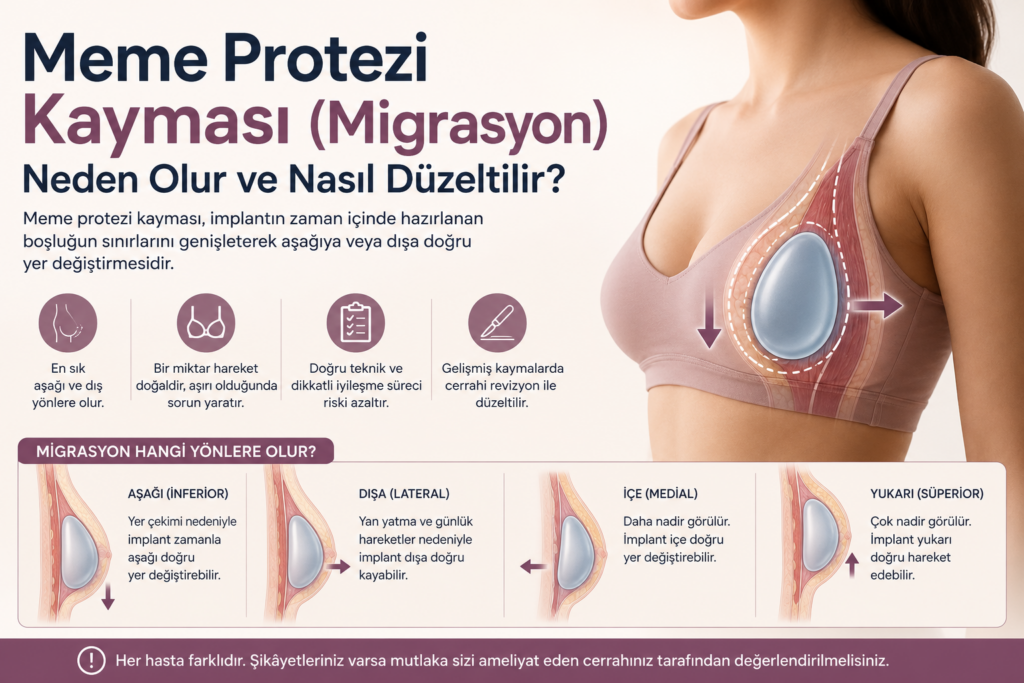
- Breast Implant Displacement (Migration): What Causes It and How Can It Be Corrected?
- Sexual Life After Breast Augmentation: When Is It Safe?

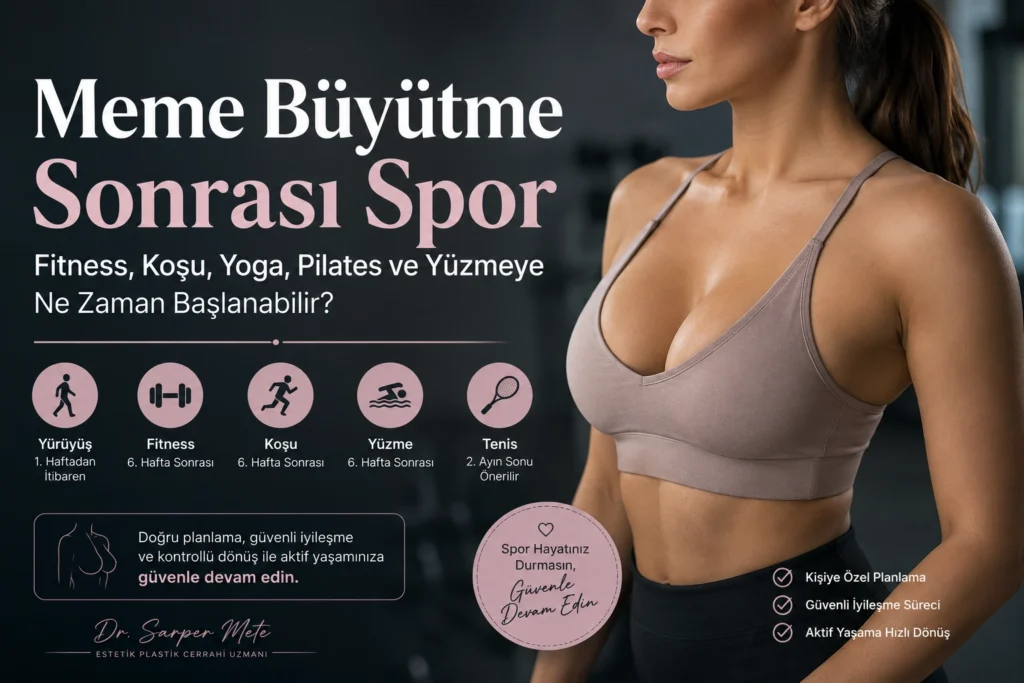
- Exercise After Breast Augmentation: When Can You Start Fitness, Running, Yoga, Pilates and Swimming?
- Can Breast Implants Burst? What You Need to Know About Implant Rupture
- What is a Fibroadenoma?