POST-OPERATIVE CARE
Wearing a Bra After Breast Augmentation
Assess the choice of support bra, the duration of use and the transition back to daily life as part of your personalised recovery plan.
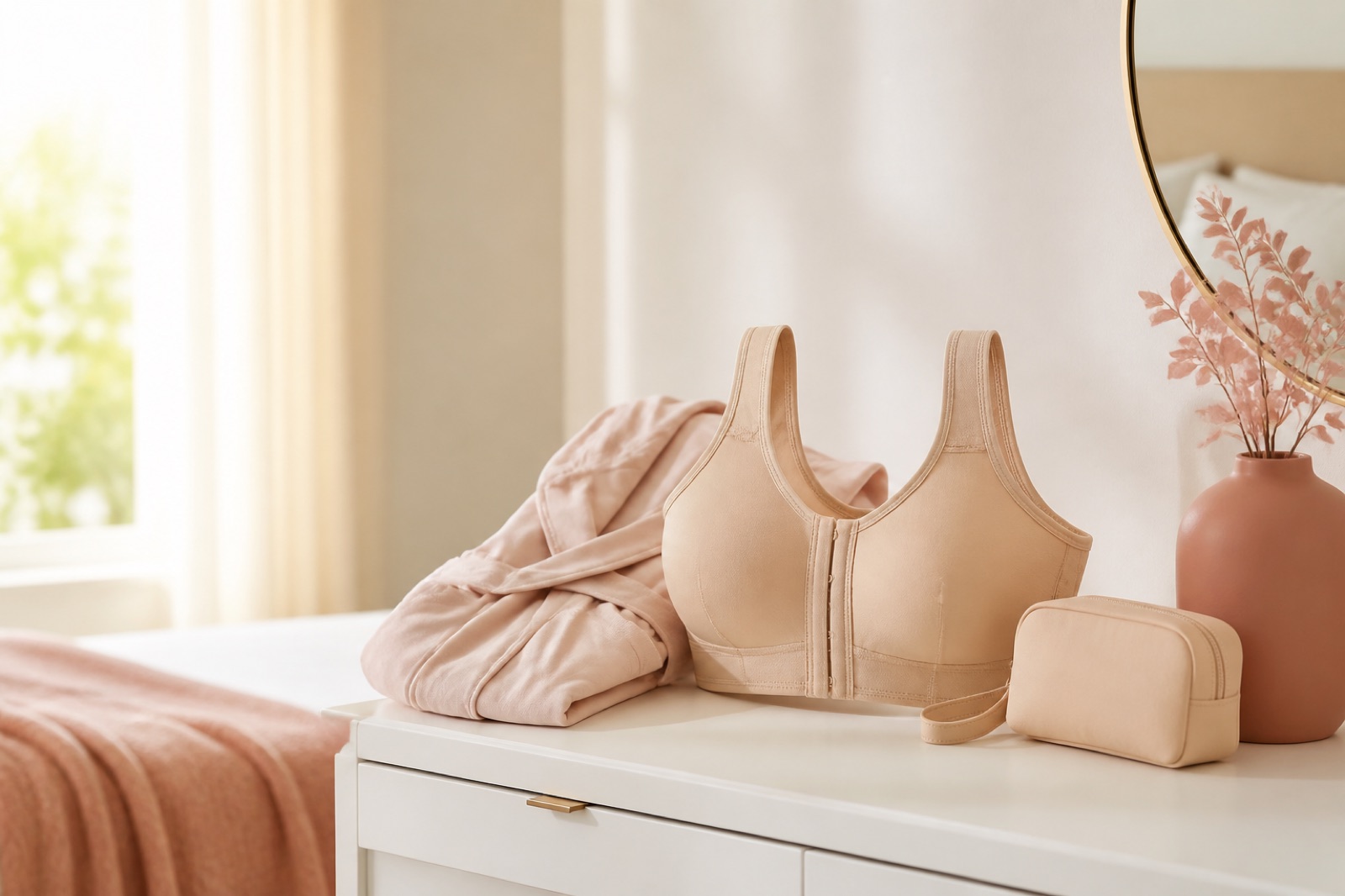
One of the questions patients most frequently ask me following breast augmentation surgery is:
“Doctor, what sort of bra should I wear?”
Actually, this is a perfectly valid question. After all, the bra you wear after surgery is not just a matter of personal choice; it is an important part of the recovery process.
You may come across a wide range of very different recommendations on this subject online. Whilst some sources recommend wearing a sports bra for months, others suggest that you can switch to a normal bra after a few weeks. You may also come across articles claiming that wearing a bra at night completely prevents sagging of the breasts, or advice suggesting that very tight bras will keep the implant in place more securely.
Because of this information overload, patients may find it difficult to work out which advice is correct.
In reality, however, the choice of bra following breast augmentation can vary depending on the characteristics of the implant used, the surgical technique employed, the breast tissue and the surgeon’s planning during the operation. For this reason, there is no single bra style or duration of use that applies to everyone.
In this article, I will share in detail both what scientific studies have shown and the bra-wearing protocol that I recommend to my patients in my own clinical practice.
Why is it important to wear a bra after breast augmentation?
First of all, we need to clear up a common misunderstanding.
The purpose of the bra worn after surgery is not to shape the breast or to hold the implant in place on its own.
The final position of the implant depends largely on;
- the implant pocket prepared during the operation,
- the surgical technique used,
- Features of the implant,
- the patient’s breast tissue,
- and the recovery process
is determined by.
A support bra, on the other hand, is a piece of equipment that aids this recovery process.

In particular, during the first few weeks following surgery, there is swelling in the breasts and the tissues are only just beginning to heal. Wearing a supportive bra during this period can help the patient feel more comfortable by reducing unnecessary movement of the breasts during everyday activities.
Furthermore, when many patients wear a support bra;
- whilst walking,
- whilst driving,
- whilst going up the stairs,
- whilst carrying out their daily activities
He states that he feels much more comfortable.
Consequently, the primary purpose of wearing a post-operative bra is to provide support for the healing tissues and to enhance the patient’s comfort.
What Type of Bra Should You Wear After Breast Augmentation?
In my own practice, I generally advise my patients who have undergone breast augmentation surgery to wear a supportive, underwire-free bra day and night for the first six weeks.
This bra;
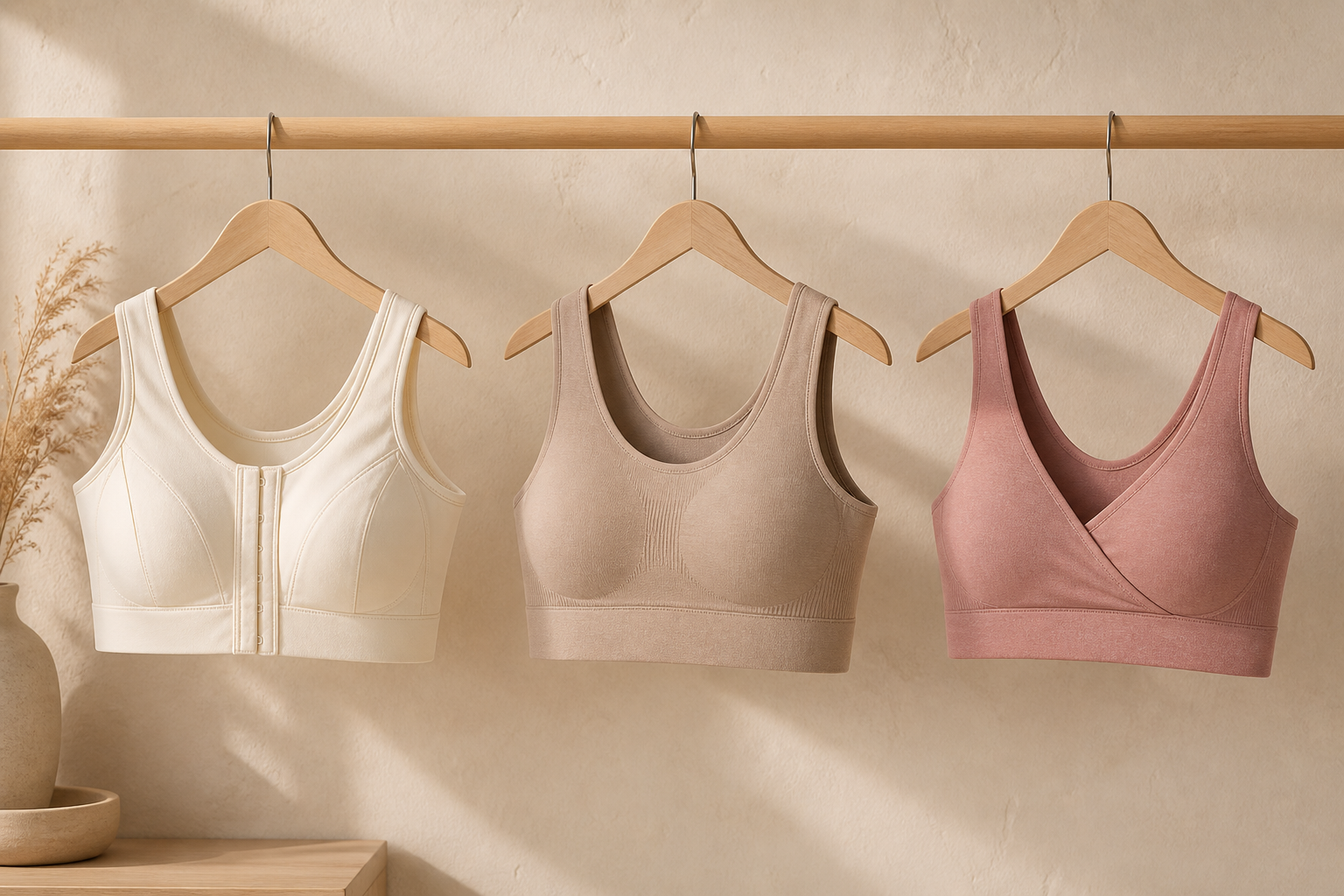
- a surgical bra worn after an operation,
- a high-quality sports bra,
- or it could be one of the medical bra models without underwires that provide sufficient support.
The important thing here is not that the bra should be as tight as possible, but that it should be comfortable whilst providing adequate support.
Whilst a bra that is too loose may not provide sufficient support, styles that are too tight can cause a feeling of pressure on the shoulders, leave marks on the skin and reduce the patient’s comfort.
As each patient’s anatomy, the volume of the implant used, the implant placement plan and the technique employed during surgery vary, bra recommendations may also differ from person to person. For this reason, the advice of the surgeon performing your operation should always take precedence.
| Period | My General Recommendation |
|---|---|
| First week | The surgical bra recommended by the surgeon should be worn day and night. The bra may only be removed whilst showering or changing the dressing. |
| Weeks 1–6 | A non-underwired surgical bra or a sports bra that provides sufficient support may be worn day and night. |
| After 6 weeks | Following a check-up and approval from the surgeon, you may gradually transition to everyday bras. |
| 4–6 months later | As swelling has largely subsided and the shape of the breasts has become more stable, this is a more suitable time to purchase permanent bras. |
Note: These timeframes are a general guide. Recommendations may vary in cases where the procedure is performed in conjunction with a breast lift or where different surgical plans are followed.
Surgical, Compression or Sports Bra: What Is the Difference?
When it comes to the bra to be worn following breast augmentation surgery, one of the questions I’m most frequently asked is:
“Should I wear a surgical bra, or would a good-quality sports bra be sufficient?”
In fact, both options share the same aim: to provide comfortable and controlled support for the breasts during the recovery process.
Surgical bras are specifically designed for the post-operative period. They are generally styles that do not irritate the incision sites, are easy to put on and take off, and can be worn comfortably throughout the day.
A high-quality sports bra, however, can be a successful alternative for many patients, particularly after the initial recovery period. The key point here, however, is that the sports bra chosen should be a style that provides high support, is underwired-free and does not constrict the breasts excessively.
In my clinical practice, I usually recommend a surgical bra during the first few weeks; later on, depending on the patient’s recovery, I suggest switching to a high-quality sports bra.
As each patient’s surgical plan is different, this recovery time may vary from person to person.
| Underbust Circumference | Approximate Bra Band Size |
|---|---|
| 63–67 cm | Size 65 |
| 68–72 cm | Size 70 |
| 73–77 cm | Size 75 |
| 78–82 cm | Size 80 |
| 83–87 cm | Size 85 |
| 88–92 cm | Size 90 |
| 93–97 cm | Size 95 |
| 98–102 cm | Size 100 |
Measurement tip: The tape measure should be placed just below the bust, parallel to the floor. It should touch the skin but should not be pulled so tight that it makes breathing difficult.
| Step | How to Measure? |
|---|---|
| 1. Measure your underbust circumference | Run the tape measure just below your bust, keeping it parallel to the floor. This measurement helps to determine your bra band size. |
| 2. Measure the bust circumference | Run the tape measure around the fullest part of your bust, usually over the nipples. The tape measure should not squeeze your breasts. |
| 3. Work out the difference between the two measurements | Subtract the underbust measurement from the bust measurement. The resulting difference indicates your approximate cup size. |
| 4. Check the fit by trying on the bra | The calculated size is only a starting point. You must check that the band, cup and straps fit your body correctly. |
Post-operative note: As swelling may persist during the first few months following breast augmentation surgery, the measurements taken may not reflect your permanent bra size. It is generally advisable to wait 4–6 months before shopping for a bra.
| The Difference Between the Chest Circumference and the Underbust Circumference | Approximate Cup Size |
|---|---|
| 10–12 cm | AA |
| 12–14 cm | A |
| 14–16 cm | B |
| 16–18 cm | C |
| 18–20 cm | D |
| 20–22 cm | E |
| 22–24 cm | F |
| 24–26 cm | G |
| 26 cm and over | Above G |
Important: Cup sizing systems and patterns may vary between brands. This table is intended as a rough guide; the correct bra size should be determined by how the bra fits on the body.
How Tight Should a Compression Bra Be?
A significant proportion of patients believe that the tighter their bra, the better they will recover.
However, this is not true.
Scientific studies show that most of the support provided to the breasts comes not from the shoulder straps, but from the band that runs around the lower chest (underband). The straps, on the other hand, help to keep the bra in place.
For this reason, using very tight straps, rather than providing greater support;
- a sensation of pressure in the shoulders,
- for neck pain,
- deep strap marks on the shoulders,
- a feeling of discomfort during the day
What could be the reason?
Interestingly, whilst some studies on sports bras have found that women feel that tighter-fitting styles provide more support, it has been shown that this does not always mean they are being worn correctly.
In other words, the support people feel is not always the same as the support that is actually needed.
My recommendation is to choose a bra that gently supports the breasts without making it difficult to breathe, does not leave noticeable pressure marks on the skin, and can be worn comfortably throughout the day.
Our aim is not to compress the breast as much as possible, but to provide controlled support during the healing process.
| Correct Fit Finding | Incorrect Fit |
|---|---|
| The under-bust band wraps horizontally around the body. | The back of the band rises towards the back. |
| The cup section wraps around the breast without any spillage or gaps. | The breast overflows the cup or there is a noticeable gap within the cup. |
| The straps rest lightly on the shoulders and support the bra’s position. | The straps dig into the shoulders, leave deep marks or slip down constantly. |
| The bra does not restrict breathing or hinder everyday movements. | When breathing, pressure, pain, numbness or a noticeable feeling of constriction is felt. |
| The bra does not need to be adjusted frequently throughout the day. | The bra constantly rides up, slips or changes position. |
What Are the Signs That a Compression Bra Is Too Tight?
Deep persistent pressure marks, increasing pain, numbness or tingling, bruising or colour change, blistering, skin injury or difficulty breathing may indicate excessive compression. Do not tighten the bra or band further without asking your surgeon if one side is under marked pressure or circulation appears affected.
How Long Should You Wear a Surgical or Compression Bra?
The first few weeks following breast augmentation surgery are a period during which the body adapts to the operation.
During this process;
- post-operative swelling gradually subsides,
- the tissues begin to heal around the implant,
- The shape of the breast changes gradually over the course of days and weeks.
For this reason, wearing a supportive bra during the first few weeks to minimise unnecessary movement of the breasts throughout the day may be beneficial in terms of both comfort and the healing process.
In my own practice, I therefore recommend that my patients wear a supportive, underwire-free bra both day and night for the first six weeks.
Of course, this timeframe is not exactly the same for every patient. Factors such as the surgical technique used, the way the implant is positioned, the characteristics of the breast tissue, and whether or not a breast lift is performed at the same time may affect our recommendations.
For this reason, rather than relying on general information found online, it is always best to follow the advice of the surgeon performing your operation.
When Can You Stop Wearing the Surgical Bra?
The timing of short breaks and stopping the bra depends on swelling, incision healing, implant placement and whether a breast lift was performed at the same time. Six weeks is a commonly used review period, but it is not a universal rule for every patient.
When Can You Sleep Without a Bra After Breast Augmentation?
Wearing a bra at night is one of the most frequently asked questions following breast augmentation surgery.
I advise my own patients not to take their bras off at night for the first six weeks.
The main purpose of this is not to ‘force the implant to stay in place’.
The main aim is;
- to support healing tissues,
- to minimise any discomfort that may arise whilst changing position at night,
- The aim is to help the patient feel more secure, particularly during the first few weeks.
So, should you continue to wear a bra at night after this period?
Scientific studies conducted to date have not produced strong evidence to suggest that wearing a bra at night prevents breast sagging in the long term or preserves the shape of breast implants.
For this reason, once the initial recovery period is over, whether or not to wear a night-time bra is largely a matter of personal comfort.
Whilst some women find it more comfortable to sleep in a bra, others prefer to sleep without one. Unless your surgeon advises otherwise, both approaches are generally acceptable options in the long term.
How Should Bra Size and Fit Be Chosen During Recovery?
After breast augmentation surgery, many patients can’t wait to go and buy a new bra. In fact, one of the questions I’m most frequently asked at the first follow-up appointment is:
“Doctor, can I have my new bras now?”
I think we shouldn’t rush things at this stage.
Following the operation, the breasts undergo constant changes from the very first day. In the first few weeks, the breasts may feel fuller and firmer than usual due to swelling. In the months that follow, the swelling subsides, the tissues soften and the implants begin to settle into a more natural position.
For this reason, it is not realistic to expect that the bra size chosen in the first few weeks following the operation will be the same as the size to be worn in the long term.
In my experience, the shape and volume of the breasts stabilise in most patients within approximately 4 to 6 months. In some patients, this period may be slightly shorter, whilst in others it may be slightly longer.
For this reason, it is generally a better idea to wear only the essential bras during the first few months and to leave more extensive shopping until the breasts have begun to take their final shape.
Does the Same Implant Result in the Same Bra Size for Every Woman?
No.
This is one of the most common misconceptions about breast augmentation surgery.
For example, even if two different patients are fitted with implants of the same volume—say, 325 cc—the bra size they will need to wear after the operation may be completely different.
It is not just the implant that is the cause.
There are many factors that influence the outcome:
- the width of a person’s ribcage,
- existing breast tissue,
- breast base diameter,
- height-to-weight ratio,
- the projection of the implant used,
- breast shape,
- pre-operative volume.
For this reason, it is not possible to say “what size you will be” simply by looking at the volume of the implant.
I explain to my patients that our aim is to achieve a natural look that harmonises with their bodies, rather than focusing on implant size. The letters or numbers on the bra label are only a small part of this.
What Is a Sister Size?
One of the concepts many women come across when shopping for bras is the ‘sister size’ system.
In fact, the same breast volume can correspond to different sizes in women with different bust measurements.
For example;
- 75C
- 80B
- 85A
These are sister sizes representing breast volumes that are quite similar.
For this reason, it is not correct to assess breast size based solely on the cup size.
As your bust measurement changes, your cup size may also change.
This situation is also frequently encountered following breast augmentation surgery. Two different patients may wear completely different bra sizes, even though they have implants of a similar volume.
That is why definitive statements found online, such as ‘300 cc = C cup’ or ‘350 cc = D cup’, do not reflect the truth.
Our aim in surgical planning is not to achieve a specific cup size, but to create a breast shape that is in harmony with the patient’s body proportions and looks natural.
| Tighter Band | Standard Fit | Looser Band |
|---|---|---|
| 65D | 70C | 75B |
| 70D | 75C | 80B |
| 75D | 80C | 85B |
| 80D | 85C | 90B |
| 70E | 75D | 80C |
| 75E | 80D | 85C |
How do you use the ‘sister size’ system? When increasing the band size by one size, the cup size is reduced by one letter. When decreasing the band size by one size, the cup size is increased by one letter. This allows the approximate cup volume to be maintained whilst adjusting the band width.
When Can You Wear a Normal, Underwire or Braless Style?
The transition to a normal bra depends on swelling, breast settling and incision healing. Underwire can irritate an incision in the breast fold or place pressure on a newly positioned inframammary fold, so the timing should follow your surgeon’s assessment.
Underwire Bras and the Breast-Fold Incision
An underwire should generally be avoided early if it presses directly on the incision or the newly established breast fold.
Bralettes, Push-Up Bras and Going Braless
There is no single timeline for a bralette, push-up bra or going without a bra. Implant placement, tissue support, a simultaneous lift and your surgeon’s protocol all affect the decision.
How Long Can a Sports Bra Be Worn?
Sports bras have been designed specifically to support the breasts during exercise. However, there is one important point that many people fail to realise:
Sports bras also lose their support over time.
Studies have shown that the support provided by sports bras begins to diminish after regular use and approximately 25 washes. In addition to washing, prolonged use can also cause the elastic fibres to lose their elasticity.
Interestingly, whilst many women continue to wear bras simply because they find them comfortable, the same studies have shown that the support provided by a bra can diminish without one realising it.
For this reason, it is important that women who exercise regularly, in particular, do not continue to wear the sports bras they have been using for years simply because they are comfortable.
Whilst a bra that has lost its elasticity may not cause any problems in everyday use, it may not provide the same level of support as it did on the first day during intense physical activity.
Is a Breast or Implant Stabiliser Band Needed for Everyone?
A breast or implant stabiliser band is not needed for every patient. It may be used in selected implant positions or when the surgeon wants to guide early settling. Do not change its position or tightness yourself, and do not assume that a bra or band can guarantee prevention of implant displacement.
The Most Common Bra Mistakes After Breast Augmentation
Some mistakes made by patients after surgery, albeit with the best of intentions, can unnecessarily complicate the recovery process.
The most common errors I come across are as follows:
- Switching to a underwired bra too early in the first few weeks.
- Thinking that a very tight bra will give better results.
- Stopping the use of a support bra before the time recommended by your doctor.
- Buying lots of expensive bras in the first few weeks.
- Prioritising general advice found online over your own surgeon’s recommendations.
- Carrying on using old sports bras that have lost their elasticity for years on end.
The best approach during the post-operative period is to follow your own surgeon’s advice rather than general recommendations found online. This is because no two operations are the same, and every patient’s recovery process is different.
Frequently Asked Questions
Is it compulsory to wear a bra after breast augmentation surgery?
Wearing a supportive bra following breast augmentation surgery can help make the recovery process more comfortable. In my own practice, I recommend that my patients wear a supportive, underwire-free bra day and night for the first six weeks.
However, as the type of bra to be worn and the duration of use may vary depending on the surgical technique employed, you should always prioritise the advice of the surgeon who performed your operation.
How long should a sports bra be worn after breast augmentation?
I usually recommend that my patients wear a non-underwired surgical bra or a high-support sports bra for the first six weeks.
At the end of this period, the transition to everyday bras can be planned according to how the healing is progressing.
Should you sleep in a bra at night?
I recommend wearing a support bra at night for the first six weeks.
Once the initial recovery period is over, however, whether to wear a bra at night is largely a matter of personal preference. To date, there is no strong scientific evidence to suggest that wearing a bra at night prevents breast sagging in the long term.
When can I start wearing an underwired bra after a breast augmentation?
The timing of switching to a underwired bra may vary depending on how the incision site heals and the specifics of the operation. You must therefore always obtain your surgeon’s approval before switching to an underwired bra in the early stages.
Will my bra size be obvious straight away after a breast augmentation?
No. As swelling and the healing process continue during the first few weeks, the volume and shape of the breasts may change over time.
For most patients, the final bra size can be assessed more accurately within approximately 4–6 months.
Does the same implant volume result in the same bra size for everyone?
No. Implant volume alone does not determine bra size.
It is influenced by a number of factors, such as the width of the ribcage, existing breast tissue, the diameter of the breast base, the projection of the implant and body type.
Do you get better results if the bra is very tight?
No. There is no scientific evidence to suggest that wearing an excessively tight bra helps the implant to settle into place better. On the contrary, bras that are too tight can cause discomfort on the shoulders and under the breasts.
Is a surgical bra or a sports bra better?
The aim of both is to provide support for the breasts during the recovery period.
Whilst surgical bras are more commonly chosen in the first few days, underwired sports bras with the right features can also be a good alternative in the weeks that follow.
Can I wear a bralette?
It can be used once the initial recovery period is over and your surgeon has given the go-ahead. However, models that provide adequate support should be chosen during the first few weeks.
Can I wear a push-up bra?
Push-up bras are not recommended during the early recovery period due to their design, which pushes the breasts upwards. You should follow your surgeon’s advice regarding when to resume normal use.
Can I go without a bra after a breast augmentation?
It is generally recommended to wear a support bra during the initial recovery period.
In the period that follows, however, there is usually no medical reason why a woman cannot go without a bra, depending on her daily routine and comfort.
Does wearing a bra after breast augmentation cause the implant to shift?
No. The main factors determining the position of the implant are the surgical technique, the implant pocket created, and the healing process. A supportive bra primarily helps to improve the patient’s comfort.
What sort of sports bra should you choose when exercising?
After returning to exercise, you should opt for high-quality sports bras that provide good support for the breasts, are underwire-free and offer a high level of support. Models that provide sufficient support, particularly for running and high-intensity exercise, may be more comfortable.
When should sports bras be replaced?
High-quality sports bras can lose their elasticity over time. As their support properties may diminish following regular use and frequent washing, it is not advisable to wear the same bra for many years.
What should you bear in mind when choosing a bra after breast augmentation?
An ideal bra should
have an underband that fits snugly around the body.
It should be the correct size,
be underwired (in the early stages),
provide gentle support for the breasts,
not cause discomfort on the shoulders,
and have an underband that fits snugly around the body.
Why is bra selection after breast augmentation tailored to the individual?
Because every patient;
- breast structure,
- skin elasticity,
- chest width,
- the implant used,
- the surgical technique used
They all differ from one another. For this reason, the advice given by the surgeon performing your operation should always take precedence over general advice you may read online.
What should I do if I’m not sure which bra to wear after a breast augmentation?
The advice available online is intended to provide general information and may not apply to every patient individually.
The style, size and duration of use of the bra you should wear may vary depending on the technique used during the operation, the type of implant used and your recovery process. Therefore, the best approach is to consult your surgeon during your follow-up appointments and follow the advice tailored specifically to you.
Stay up to date